

Key Takeaways
What SPF Actually Measures
SPF stands for sun protection factor, and it only tells you one thing: how well a sunblock shields you from UVB rays. Those are the rays that cause sunburn and most surface sun damage. The number is a ratio, not a percentage. An SPF 30 means it would take your skin about 30 times longer to burn than with no sunscreen at all, in lab conditions.
Here's the part the marketing skips: SPF says nothing about UVA, the deeper rays linked to premature aging, dark spots, and pigmentation. A high number on a sunblock that isn't broad-spectrum still leaves half the problem unsolved. To protect your skin from both UVA and UVB, you need a broad-spectrum product, not just a big SPF figure.
The Percentage of UV Each SPF Blocks
This is where the SPF 30 vs 50 question usually falls apart. The numbers sound far apart, but the actual UVB they block is close. Here's what each one filters out.
| SPF Rating | UVB Rays Blocked | UVB Rays Let Through |
|---|---|---|
| SPF 15 | ~93% | ~7% |
| SPF 30 | ~97% | ~3% |
| SPF 50 | ~98% | ~2% |
| SPF 60 | ~98.3% | ~1.7% |
So in the SPF 50 vs 60 debate, you're arguing over about three-tenths of a percentage point. A sunblock SPF 60 does block slightly more UVB rays than SPF 50, but the real-world difference is tiny once you account for how the product is actually worn.
Why Higher SPF Gives Diminishing Returns
People assume SPF 60 is double the protection of SPF 30 because the number doubled. It isn't. SPF 30 already blocks roughly 97% of UVB rays. There's only 3% left to improve on, so even a "perfect" sunblock could only add three more points. SPF 50 takes you to about 98%, and a sunblock SPF 60 nudges that to around 98.3%.
That's the diminishing-returns curve in plain terms. Each step up the SPF scale buys you a smaller and smaller slice of extra UVB protection. This is also why dermatologists rarely push past SPF 50 for daily use. Once you're filtering 98% of UVB rays, a higher number on the bottle is more marketing than meaningful sun protection.
What PA+++ Means (and Why UVA Matters)
SPF is only half the label. The PA rating, written as PA+, PA++, or PA+++, measures how well a product defends against UVA rays. UVA penetrates deeper than UVB, doesn't cause an obvious sunburn, and quietly drives premature aging, dark spots, and pigmentation over the years.
More plus signs mean stronger UVA defense, so PA+++ is the level you want for everyday wear. A sunblock that covers both UVA and UVB is labeled broad-spectrum. That broad-spectrum label matters far more than chasing SPF 60. You'll get better all-around sun protection from a broad-spectrum SPF 50 PA+++ than from a high-SPF product that ignores UVA entirely.
How Much to Apply (the Real Reason Your SPF Underperforms)
Here's the uncomfortable truth: the SPF number barely matters if you under-apply, and almost everyone does. SPF ratings are tested using 2 milligrams of product per square centimeter of skin. Most people apply a quarter to half of that, which means a labeled SPF 50 might be performing more like an SPF 15 to 25 on your face.
Under-applying is the single biggest reason any sunblock underperforms, far more than the gap between SPF 30, 50, and 60. To actually get the protection on the bottle:
- Use enough. About two fingers' worth of product for the face and neck.
- Apply it as the last step of your skincare, 15 minutes before sun exposure if you're using a chemical formula, so it can bind to the skin.
- Cover the exposed areas people forget: ears, hairline, neck, and the backs of your hands.
- Reapply every two hours, and right after you sweat, swim, or towel off.
A correctly applied SPF 50 protects you better than a thin, patchy layer of SPF 60. That's the whole point: how much you use beats which number you buy.
Which SPF for Which Situation
So which SPF is best? It depends on your day, not on grabbing the highest number on the shelf:
- Daily indoor and commuting use: A broad-spectrum SPF 30 to 50 is plenty for most skin types. The SPF 30 vs 50 difference is marginal here, so pick the texture you'll actually wear every day.
- Long hours outdoors, beach, or hiking: Step up to SPF 50 (or a sunblock SPF 60 if you like the extra margin), and reapply more often. The reapplication matters more than the rating.
- Oily or acne-prone skin: Choose a non-greasy, oil-free, matte formula so it doesn't slide off. Our guide to the best sunblock for every skin type breaks down each one.
- Sensitive skin or simple confusion about labels: Mineral filters like zinc oxide and titanium dioxide are gentle and broad-spectrum. If you're unsure whether you even need "sunblock" or "sunscreen," our explainer on sunscreen vs sunblock clears it up.
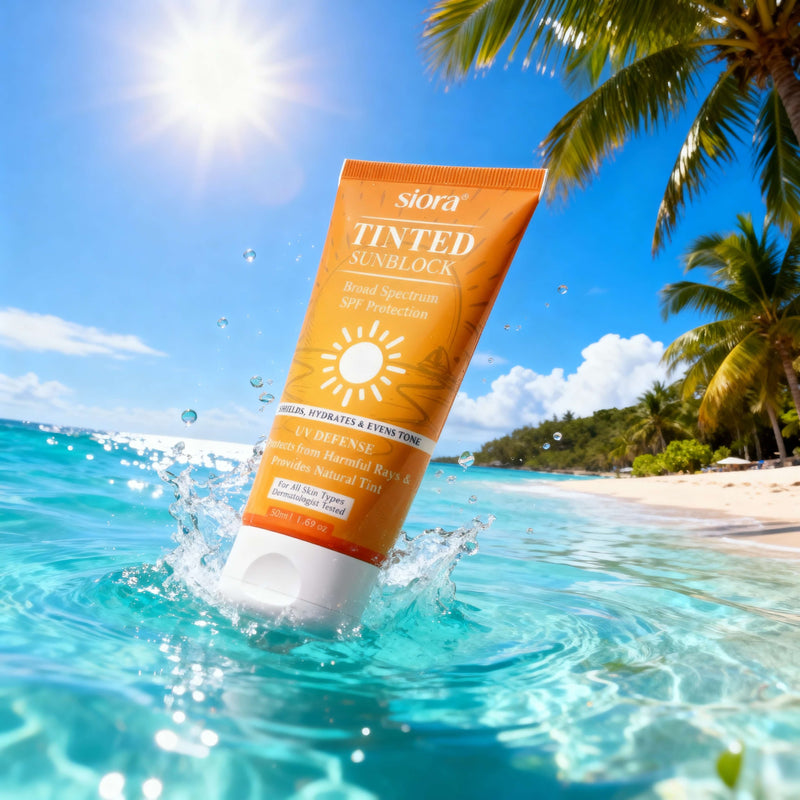
For a lightweight daily option that covers both UVA and UVB, Siora's Sun Block Protect Matte & Prevent (Tinted SPF50 PA+++, 2x) gives broad-spectrum, non-greasy coverage in one step. Siora's formulation team built it to sit matte through a Pakistani afternoon without a heavy white cast, which makes it easy to apply enough and reapply, the part that actually decides how well your sunblock works.