

Key Takeaways
What Sunblock (Physical / Mineral Sunscreen) Is
Sunblock acts as a physical shield. The term "sunblock" describes a product that contains mineral ingredients, usually zinc oxide or titanium dioxide, that sit on the skin's surface and reflect UV light away before it gets in. In practice, sunblock reflects the sun's rays like a tiny mirror, so it blocks UV rays at the surface rather than letting them sink in. Because it doesn't absorb into the skin, mineral sunblock starts working the moment you apply it.
This is why a lot of people with reactive or sensitive skin reach for mineral sunscreen. The ingredients are inert and don't break down in sunlight the way some chemical filters do. The classic trade-off was the white cast that thick zinc formulas leave behind, though modern tinted versions have mostly solved that.
What Sunscreen (Chemical) Is
Sunscreen, in the chemical sense, works the opposite way. Instead of reflecting light, a chemical sunscreen contains filters such as avobenzone, oxybenzone, or octinoxate that absorb UV rays, convert them into a small amount of heat, and release it from the skin. Sunscreen absorbs UV rays rather than bouncing them off.
The upside is texture. Because these formulas are designed to soak in, they feel lightweight and leave no white residue, which makes them popular for everyday wear under makeup. The catch is timing: most chemical sunscreen needs around 15 to 20 minutes to bind to the skin before it's fully effective, so apply it before you head out.
The Difference Between Sunscreen and Sunblock at a Glance
Here's the difference between sunblock and sunscreen laid out so you can see what's the difference at a glance. The table compares how each works, the sunscreen ingredients involved, and the finish you can expect.
| Feature | Sunblock (Mineral / Physical) | Sunscreen (Chemical) |
|---|---|---|
| How it works | Reflects UV rays off the skin's surface | Absorbs UV rays and disperses them as heat |
| Key ingredients | Zinc oxide, titanium dioxide | Avobenzone, oxybenzone, octinoxate |
| Finish | Can leave a white cast (less so with tinted formulas) | Sheer, lightweight, no residue |
| White cast | Possible on deeper skin tones; tinted versions fix this | None |
| Best for | Sensitive, reactive, or acne-prone skin | Daily wear, oily skin, under makeup |
| Works on contact? | Yes, immediately | No, needs 15-20 minutes first |
Which Is Better for Which Skin Type?
So is sunblock better than sunscreen? Neither wins outright. Once you understand the difference between sunscreen and sunblock, the better option comes down to your skin and routine, not the marketing on the bottle. A formula you'll actually reapply will always beat a higher-rated one you leave in the drawer. Here's how to choose the right one:
- Sensitive or rosacea-prone skin: Mineral sunblock with zinc oxide or titanium dioxide is the safer bet, since it's less likely to sting or trigger redness.
- Oily or acne-prone skin: A lightweight, matte-finish formula keeps shine down. A tinted mineral option doubles as light coverage. Our guide to tinted sunblock for oily skin walks through the best picks.
- Dry or mature skin: Either type works, so look for added hydration and a comfortable finish.
For a full breakdown by skin type, our pillar guide on the best sunblock for every skin type covers each one in detail.
What SPF and PA Mean for Sun Protection
The two ratings on every bottle tell you what kind of sun protection you're actually getting.
SPF stands for sun protection factor. It measures how well a product shields you from UVB rays, the ones that cause sunburn and contribute to skin cancer. An SPF 30 or higher filters out roughly 97% of UVB rays, which is the level the American Academy of Dermatology and most dermatologists recommend for daily use. Higher numbers add only marginal extra coverage, so SPF 30 to 50 is the practical sweet spot.
PA tells you about UVA protection. UVA rays penetrate deeper and drive premature aging without an obvious sunburn, so they're easy to underestimate. The more plus signs (PA+, PA++, PA+++), the stronger the UVA defense. A product that protects against both UVA and UVB rays is labeled broad-spectrum, and that's the label you want for all-around sun protection.
How to Use Either One Correctly
Even the best sun protection products only work if you apply them right, whether you use sunscreen or sunblock:
- Use enough. Most people apply too little. You need about two fingers' worth for the face and neck.
- Apply it last in skincare, before makeup. With a chemical sunscreen, give it 15 to 20 minutes to absorb first.
- Reapply every two hours, and right after you sweat, swim, or towel off.
- Don't skip cloudy days. Most UV rays pass through clouds, so daily use matters year-round.
Reapplication is where most sun protection falls apart. No formula keeps blocking UV rays all day on a single morning layer, because sweat, water, and ordinary rubbing wear it off. That's why swimming or sweating is the trigger to top up, even if it hasn't been a full two hours. Keep a travel-size bottle in your bag so a midday reapply is easy, and remember that a mineral sunscreen reflects the sun's rays from the moment you put it back on, with no waiting period.
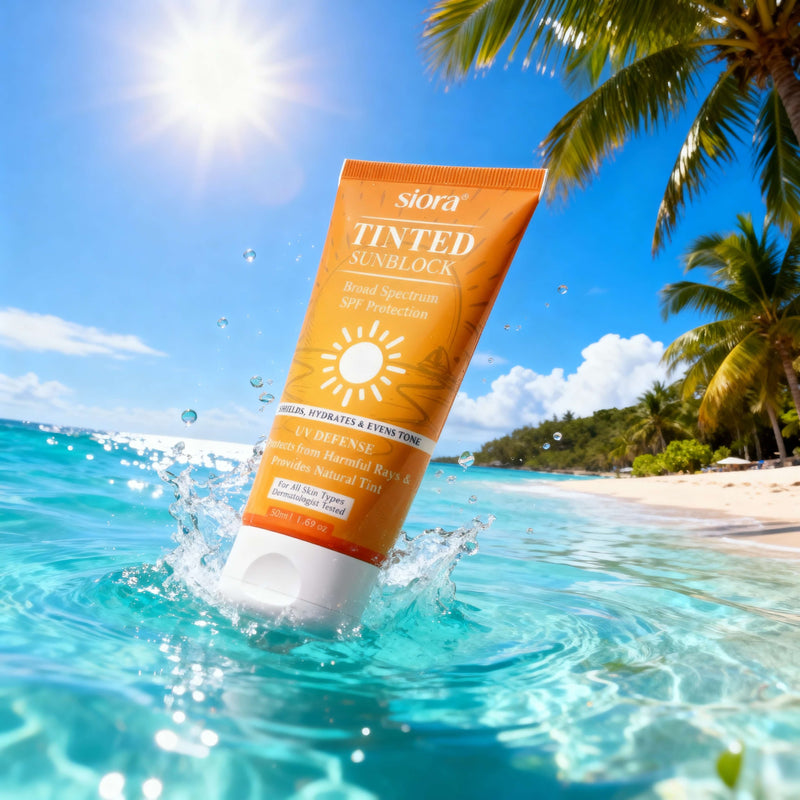
For a tinted formula that covers both bases, Siora's Sun Block Protect Matte & Prevent (Tinted SPF50 PA+++, 2x) gives broad-spectrum, matte coverage in one step. Siora's formulation team built it to wear comfortably through a hot afternoon without a heavy white finish.