

Key Takeaways
Siora Retinol Serum at a Glance
| Detail | Specification |
|---|---|
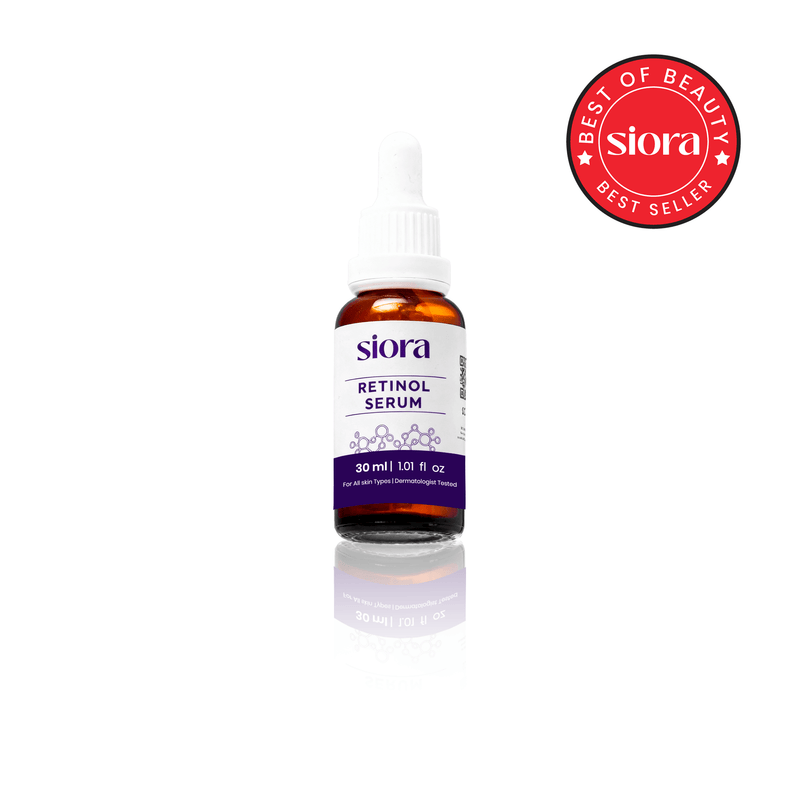
| Product | Siora Retinol Serum (Renew & Smooth) |
| Hero active | Encapsulated retinol 0.3% (time-release pure retinol) |
| Size | 30ml |
| Price | 1290 |
| Best for | Fine lines, uneven texture, early signs of aging, dull skin |
| Skin type | Normal, dry, oily, combination, sensitive (with slow start) |
| When to use | Night only, on clean dry skin |
| Texture | Lightweight serum, fast-absorbing, non-greasy skin feel |
| Free from | Fragrance, parabens, alcohol drying agents |
| Pregnancy | Not recommended (see warning below) |
What This Retinol Serum Does for Your Skin
Retinol is a vitamin A derivative and one of the most studied active ingredients in anti aging skincare. It works by speeding up skin cell turnover and signalling deeper layers to boost collagen production. The result over time is that it improves skin texture and tone, softens fine lines and wrinkles, and leaves a clearer, more even skin tone. Because retinol is a true retinoid, it converts in your skin into retinoic acid, the form that actually drives renewal. Among the best retinol products, the ones that pair this kind of retinol anti aging action with a gentle delivery system are the ones beginners stick with.
What makes Siora's version different is the encapsulated delivery. Plain retinol can hit sensitive skin all at once, which is why so many people quit after a week of redness. Our encapsulated retinol releases slowly through the night, so you get the renewal benefits of retinol with far less of the irritation that scares beginners away. That's the whole point of a gentle retinol: results without the drama.
How retinol serums actually work
Once it absorbs, retinol gets converted by your skin cells into retinoic acid. That active form binds to receptors deep in the skin and switches on two things: faster cell turnover at the surface and more collagen production in the lower layers. The surface renewal is what improves skin texture and clears dull, flaky build-up. The collagen support is what, over months, helps reduce the appearance of fine lines and wrinkles. This dual action is why dermatologists rate retinol so highly among anti-aging active ingredients, and why a well-made retinol serum can do the work of several separate products.
The benefits and effects of retinol compound the longer you use it. Unlike a quick-fix serum for fine lines that only sits on the surface, retinol changes how your skin behaves at a cellular level. That's also why retinol is a "night serum" by nature: sunlight degrades it, so it does its best work overnight while you sleep, then you protect the fresh skin with SPF the next day. Retinol can be used on the face, neck, and chest, which makes a single bottle stretch across the areas where ageing shows first.
Here's what to actually expect, because retinol is a long game, not an overnight fix:
| Timeline | What's happening | What you'll notice |
|---|---|---|
| Week 1 | Skin begins adjusting to retinol | Possible mild dryness or tightness. Normal. |
| Weeks 2–4 | Cell turnover speeds up (the "purging" phase) | Some small breakouts may surface faster than usual, then clear. |
| Weeks 4–8 | Surface renewal stabilises | Smoother, brighter skin texture and a healthier skin feel. |
| Week 8+ | Texture visibly improves | Refined pores, more even tone, less roughness. |
| Week 12+ | Collagen support shows up | Softer fine lines and a reduced appearance of fine lines around eyes and mouth. |
This is why consistency beats strength. A beginner who uses a 0.3% serum twice a week for three months will see better results than someone who slaps on a strong retinol product nightly and burns their face in week one.
Key Anti-Aging Benefits for Fine Lines and Wrinkles
- Smooths fine lines and wrinkles. Retinol's effect on collagen production helps soften lines and wrinkles, especially the early ones.
- Improves skin texture. Faster skin cell turnover means rougher, dull patches give way to smoother skin.
- Targets early signs of aging. A go-to for anti-aging because it works on tone, lines, and firmness at once.
- Helps with breakouts. Because it keeps pores clearing, retinol can reduce congestion and blackheads over time.
- Beginner-friendly. The encapsulated, gentle retinol formula is one of the easier ways to start retinol on sensitive skin.
- Lightweight skin feel. Absorbs fast, layers cleanly under a night cream, no heavy residue.
Who Is This Retinol Serum For?
This serum suits most people who want a beginner retinol they won't quit. It works across skin types: dry skin (pair it with a richer moisturiser), oily skin (the lightweight serum won't clog), combination, and sensitive skin (start slow). It's a strong fit if you're noticing the first fine lines, uneven texture, or dullness and want a simple anti-aging step that does a lot of work for the price.
What age should you start retinol?
Most people benefit from starting retinol in their mid-to-late 20s, when collagen production naturally begins to slow and the first signs of aging appear. There's no hard rule. If you're in your 30s, 40s, or beyond and have never used a retinol serum, this 0.3% concentration is still the right place to begin. Starting at a low retinol concentration and building tolerance matters far more than your age.
Who should NOT use retinol serum?
Avoid retinol if you're pregnant or breastfeeding (more on that below), if your skin barrier is currently damaged or peeling, or if you're mid-treatment for a skin condition and your doctor has told you to pause actives. If you have very reactive, sensitive skin, patch test first and build up slowly rather than avoiding retinol entirely.
Retinol for Different Skin Types
Your skin type changes how you start using retinol, not whether you can. Here is how to approach it.
Retinol for sensitive skin
If you have sensitive skin, the encapsulated 0.3% formula is your safest entry point. Begin twice a week, buffer with moisturiser, and let your barrier set the pace. Sensitive skin reacts to plain retinol because it hits all at once, which the time-release delivery is designed to prevent.
Retinol for dry skin
Dry skin loves retinol but needs extra moisture alongside it. Pair the serum with a richer cream and a hydrating layer so the active renews without leaving dry skin tight or flaky. The sandwich method works especially well here.
Retinol for acne-prone skin
For acne-prone skin, retinol keeps pores clearing and helps congestion settle over time. Expect a short purge in the first few weeks, then steadier, calmer skin as turnover regulates.
Gentle alternative: retinol and bakuchiol
If even a low strength feels like too much, look at retinol and bakuchiol together or on alternate nights. Bakuchiol is a plant-based alternative to retinol that delivers some of the same smoothing without the vitamin A load, making it a gentler stepping stone for very reactive skin.
Retinol Strength Guide for Beginners
One of the most common mistakes is reaching for the highest number. With retinol, more isn't better. Here's how retinol concentration maps to experience level:
| Strength | Who it's for | Notes |
|---|---|---|
| 0.2% – 0.3% | Beginne sensitive skin, anyone new to retinol | Siora sits here. Ideal first retinol serum. Build tolerance. |
| 0.5% | Comfortable users after 3–6 months | Step up only once 0.3% causes zero irritation. |
| 1.0% | Experienced retinol users | Strong. Not for beginners. Can you use 1% retinol every day? Most skin can't. |
If you've never used a retinol product, 0.3% encapsulated retinol gives you real anti-aging results with the lowest risk of irritation. You can always graduate to a stronger retinol formula later from the full Siora serum collection.
Retinol Serum vs Retinol Cream vs Night Cream
Retinol Serum vs Retinol Cream: Which Is Better?
People often ask whether to pick a retinol serum, a retinol cream, or a retinol night cream. The short version: it comes down to texture and where you are in your routine. Even the best retinol cream tends to be richer and harder to dose, while a serum lets you control the exact amount as you build tolerance.
| Format | Best for | Skin feel |
|---|---|---|
| Retinol serum (Siora) | All skin types, especially oily and combination; layering under moisturiser | Lightweight, fast-absorbing, controllable dose |
| Retinol cream | Very dry skin that wants the active and moisture in one step | Richer, heavier; harder to control the exact amount |
| Retinol night cream | People who want a simple one-and-done last step | Thick, occlusive; can feel heavy in our humid weather |
A serum wins for most people in Pakistan because it's light, it layers cleanly under your night cream, and it lets you control exactly how much retinol you apply while you build tolerance. You get the active in a serum and the moisture from a separate cream, which is easier on the skin barrier than a heavy all-in-one in hot weather.
Best Drugstore Retinol vs Siora
If you've shopped for the best drugstore retinol, you've seen two problems: many drugstore options either hide their retinol concentration or use unstable, plain retinol that oxidises fast and irritates sensitive skin. Siora's encapsulated 0.3% retinol gives you a clearly stated strength, a stable delivery system, and a beginner-friendly dose, at a reasonable price tag that competes with drugstore picks while behaving more like a considered, dermatologist-style formula. You're not paying for a famous label like a Shani Darden Retinol Reform or an A-Passioni retinol cream; you're paying for the retinol that works, formulated for our climate.
Side Effects and How to Avoid Them
Retinol is safe for most skin types when introduced properly, but it does have a learning curve. Common early side effects include mild dryness, flaking, tightness, slight redness, and the purge in weeks 2–4. These are signs the retinol is working, not damaging your skin. Can retinol damage the skin? Only when it's overused: too much, too often, too soon. That's when you risk a compromised barrier.
To avoid side effects: start at twice a week, use a pea-sized amount, never apply to damp skin, buffer with moisturiser using the sandwich method, layer hydration with hyaluronic acid, and wear SPF daily. If your skin ever stings, peels heavily, or stays red, scale back frequency and let your barrier recover before resuming. Slow and steady is how you win with retinol.
Where can you apply retinol?
Beyond the face, you can apply retinol to the neck, chest, and backs of the hands, where signs of aging show up just as much but often get ignored. Use the same go-slow approach and the same SPF rule on those areas. Avoid broken skin, the immediate eye area lid, and the corners of the nose where product can pool.
Pregnancy-Safe Alternative: Plant-Based Retinol
If you can't use retinol right now, bakuchiol is a plant-based retinol alternative that mimics some of retinol's smoothing effects without the vitamin A risk. It's gentler, pregnancy-friendly (still confirm with your doctor), and a reasonable bridge until you can return to a true retinol serum. Vitamin C and niacinamide are also excellent supporting actives for tone and brightness while you wait.
How to Use Retinol Serum Without Purging
The trick to using a retinol without the angry-skin phase is patience and a buffer. Follow this:
- Patch test. Apply a small amount to your inner arm or jawline for two nights before going full-face.
- Start twice a week. Night only. Increase to alternate nights after 2–3 weeks if your skin feels happy, then nightly if it can take it.
- Cleanse and fully dry. Applying retinol to damp skin increases absorption and irritation. Wait 10–15 minutes after washing.
- Use a pea-sized amount. For your whole face. More serum does not mean more results, it means more irritation.
- Try the sandwich method. Apply a thin layer of moisturiser, then your retinol serum, then moisturiser again. This buffers sensitive skin and cuts down dryness without killing the results.
- Layer with hyaluronic acid. Hydration is your best friend on retinol. Use our Hyaluronic Acid Serum underneath or mixed into your moisturiser to keep skin plump and calm.
- Lock it in. Finish with a night cream to seal moisture while the retinol works overnight.
- SPF every morning, no exceptions. Retinol makes skin more sun-sensitive. Skip sunscreen and you undo the anti-aging work and risk dark spots.
If a few small breakouts appear in weeks 2–4, that's purging, not the serum failing. Keep going at the same frequency. Don't scrub, don't pick, and don't quit.
What NOT to Mix With Retinol
Retinol is powerful, and stacking it with other strong actives on the same night is how beginners wreck their skin barrier. Keep these apart:
- Vitamin C: Use vitamin C in the morning and retinol at night. They work beautifully in the same routine, just not in the same step.
- AHA / BHA exfoliants (glycolic, salicylic): Don't layer with retinol on the same night. Alternate evenings instead.
- Benzoyl peroxide: Can deactivate retinol and over-dry skin. Separate them.
- Strong scrubs: Skip physical exfoliation while you're building retinol tolerance.
What pairs perfectly with retinol: hyaluronic acid, niacinamide, peptides, ceramides, and a good moisturiser. These calm and hydrate while the retinol renews.
Where retinol fits in your skincare routine
Here's a simple, beginner-proof skincare routine that lets vitamin C and retinol work together without clashing:
- Morning: Cleanser → vitamin C serum (for brightness and antioxidant defence) → moisturiser → SPF. This is your protection-and-glow routine.
- Night (retinol nights): Cleanser → wait until skin is fully dry → Siora Retinol Serum → moisturiser or night cream. This is your repair-and-renew routine.
- Off nights: Cleanser → hydrating serum → moisturiser. Give your skin a break from actives on the nights you skip retinol.
Splitting your actives across morning and night is the safest way to get the smoothing power of retinol and the brightening power of vitamin C without overwhelming sensitive skin. Over time this routine is what visibly smooths fine lines, supports skin cell turnover, and keeps tone even, the compounding payoff of staying consistent.
Pregnancy & breastfeeding warning: Do not use retinol, or any retinoid, if you're pregnant or breastfeeding. Vitamin A derivatives are not considered safe during pregnancy. If you're expecting or nursing, pause this serum and speak to your doctor about pregnancy-safe alternatives such as vitamin C, niacinamide, or bakuchiol (a plant-based retinol alternative).
Active Ingredients Note
Siora Retinol Serum is built around encapsulated retinol (0.3%) as the hero, supported by hydrating and barrier-friendly ingredients so the active ingredients can do their work without stripping your skin. There's no added fragrance, no drying alcohol, and no harsh fillers. It's formulated by Siora's formulation team specifically for skin in our climate, where heat and strong sun demand a gentler retinol product. As with any retinol, individual results vary by skin type and consistency.