

Key Takeaways
Walk through any pharmacy in Lahore or scroll any Pakistani skin care group on Facebook and you'll see the same question on repeat: which retinol serum should I buy, and will it ruin my skin before it fixes it? Fair question. Retinol has a reputation for delivering real results and for punishing people who rush it.
This guide covers everything in one place: what retinol actually does, what age to start, which percentage to pick, how to use a retinol serum without the dreaded purge, and how to make it work in Pakistan's sun and humidity. If you're newer to serums in general, our complete face serums guide for Pakistan is a good place to get your bearings first.
What Is Retinol? The Active Ingredient Explained
Retinol is a form of vitamin A and a member of the retinoid family, a group of compounds that has been studied in dermatology for decades. Prescription retinoids like tretinoin sit at the strong end of the spectrum. Over-the-counter retinol is the gentler cousin: slower to act, but far easier for most skin types to tolerate without a doctor's supervision.
Here's how retinol works once it's on your skin. Your body converts it, step by step, into retinoic acid, the form your skin cells can actually use. That retinoic acid does two important things:
- It accelerates skin cell turnover. Young skin replaces itself roughly every 28 days. That cycle slows with age, leaving dull, rough patches and clogged pores. It pushes fresh cells to the surface faster, which is why skin starts to look brighter and feel smoother within a couple of months.
- It supports collagen production. Collagen is the protein scaffolding that keeps skin firm. Retinoids signal your skin to produce more of it while slowing the enzymes that break it down. This is the mechanism behind retinol's effect on fine lines and wrinkles, and it's backed by some of the most consistent findings in skincare research.
That dual action is why one retinol product can address so many concerns at once: the appearance of fine lines, acne, enlarged pores, uneven skin tone and rough texture. No other single ingredient available without a prescription covers that much ground, which is why dermatologists keep recommending retinoids year after year.
One clarification, because the shelves are confusing: retinol serum, retinol cream and retinol oil all deliver the same active ingredient. A serum is simply a lightweight, fast-absorbing format, which suits Pakistan's humid summers far better than a heavy cream that sits on the skin.
Benefits of Retinol: A Realistic Week-by-Week Timeline
The results are real, but they are not fast. Anyone promising overnight results is selling you something. Here's what the evidence and real-world use actually support, assuming consistent application two to three nights a week:
| Timeframe | What's happening underneath | What you'll see |
|---|---|---|
| Weeks 1–2 | Skin is adjusting to faster cell turnover | Possible mild dryness, tightness or flaking. Nothing visible yet. Normal. |
| Weeks 2–4 | Congestion is pushed to the surface faster | The "purge" window: small breakouts where you usually break out. Frustrating, temporary, and a sign retinol works. |
| Weeks 4–8 | Fresh cells dominate the surface layer | Smoother skin texture, a brighter look overall, pores appear less prominent. |
| Week 8–12 | Pigment distribution evens out | Dark spots and uneven skin tone start to fade. Skin texture and tone look noticeably more even. |
| Week 12+ | New collagen accumulates in the dermis | The appearance of fine lines softens, starting around the eyes and mouth. Improvement continues for months. |
Notice that the headline anti-aging benefits arrive last; any honest serum for fine lines asks for around three months of patience. Collagen remodelling is slow biology, and there's no way to rush it. The people who say it changed their skin are the ones who stayed consistent past week 12. The people who say it "didn't work" usually quit during the purge.
What Age Should You Start Using Retinol?
There's no law that says you must start retinol at 25, but the mid-twenties is a sensible benchmark for one simple reason: that's when your natural collagen supply begins its slow decline, dropping roughly one percent per year. Starting a retinol treatment before deep wrinkles form means you're preserving collagen rather than trying to rebuild it later, and prevention is always the easier job.
A quick guide by decade:
- Early to mid 20s: Start if you have acne, congestion or early sun damage. Otherwise, a low-strength beginner retinol once or twice a week is plenty as a preventive step.
- Late 20s to 30s: The sweet spot. The first signs of aging, faint lines around the eyes, slower glow, post-blemish marks, respond beautifully to retinol use at this stage.
- 40s and beyond: Absolutely still worth it. It keeps stimulating collagen at any age. You may simply need more patience and a richer night cream alongside it, especially if you have dry skin.
It's never too late to start, and starting "too early" carries little risk as long as you use a sensible strength. What matters far more than your age is how you introduce it, which brings us to percentages.
Retinol Percentage Guide: Which Strength Should Beginners Use?
Strength is where most people go wrong. Pakistani buyers often grab the highest number on the shelf, like The Ordinary Retinol 0.5 or even 1%, assuming stronger means faster. What stronger usually means for a first-timer is a red, flaking face and a bottle abandoned in a drawer.
| Strength | Best for | What to expect |
|---|---|---|
| 0.1%–0.3% | Complete beginners, sensitive skin, dry skin | Minimal irritation, slower but real results. The smart starting point for almost everyone. |
| 0.3%–0.5% | Skin already comfortable with low-strength retinol | The proven middle ground. Strong enough to smooth fine lines and even out tone, with manageable adjustment. |
| 1% | Experienced users with resilient skin | Faster visible change, noticeably higher chance of dryness and peeling. Not a beginner product. |
| Prescription retinoids | Stubborn acne, significant photoaging | Dermatologist-supervised only. Stronger results, stronger side effects. |
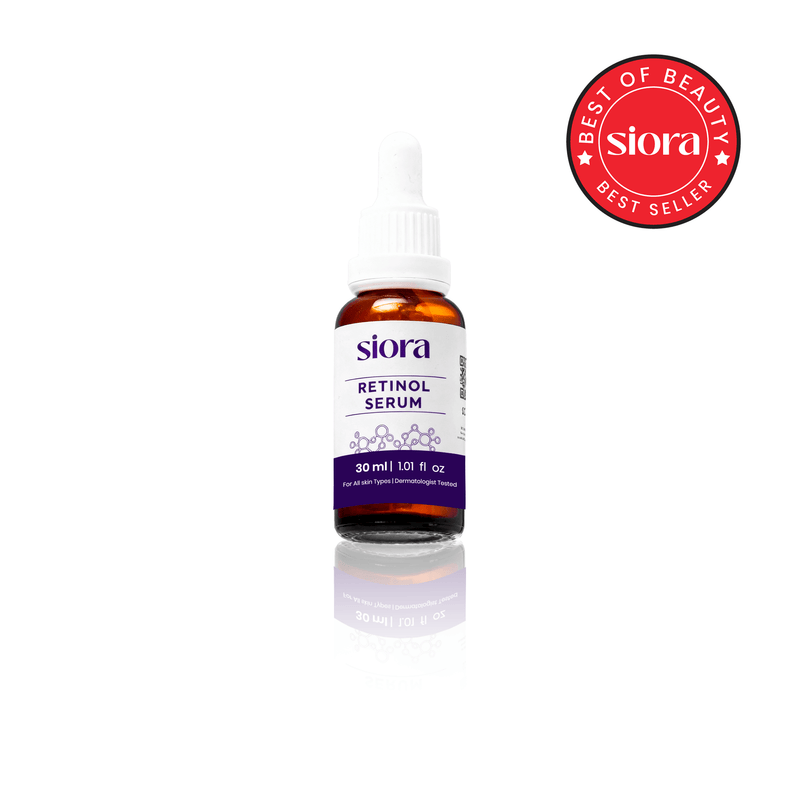
Formulation matters as much as the number. Encapsulated retinol, where the pure retinol is wrapped in a delivery system that releases it gradually, causes meaningfully less irritation than the same percentage dumped on the skin at once. Siora's Retinol Serum (Renew & Smooth) uses exactly this approach: a gentle retinol concentration formulated by Siora's formulation team specifically for first-time users and humid-climate skin, buffered with soothing hydrators, for Rs 1,690 with cash on delivery anywhere in Pakistan.
The honest rule: the best retinol is the one mild enough that you'll actually use it three nights a week for six months. A 1% serum used twice and abandoned does nothing.
How to Use a Retinol Serum Without Purging Your Skin
You can't fully guarantee a purge-free start, since purging is your skin clearing backlogged congestion faster. But you can make the adjustment period dramatically milder. Here's the routine Siora's formulation team recommends to every new customer:
- Patch test first. Apply a small amount behind your ear or on your inner arm for two or three nights. No reaction means you're clear to start.
- Start two nights a week. Monday and Thursday, for example. Hold that frequency for two full weeks before even thinking about more.
- Apply to completely dry skin. Wash your face, then wait 10 to 15 minutes. Damp skin absorbs retinol faster and stings more. This single step prevents a huge amount of unnecessary irritation.
- Use a pea-sized amount for the whole face. More product does not mean more results; it means more flaking. One pea, spread evenly, avoiding the eyelids and the corners of the nose and mouth.
- Try the sandwich method if you're nervous. Moisturizer first, then retinol, then a second light layer on top. The first layer slows absorption, taking the edge off for sensitive skin without cancelling the benefit. It's the best on-ramp for beginners we know.
- Always finish with moisturizer. Yes, layering it over retinol is allowed, and you should, every time. It locks in hydration while the active gets to work overnight.
- Increase slowly. After two comfortable weeks, go to three nights. After a month or two, every other night. Many people never need daily use, and that's fine; consistency beats frequency.
If you do hit a rough patch of flaking or redness, don't quit. Drop back to once or twice a week, moisturize generously, and let your skin catch up. Mild, short-lived irritation is part of the adjustment; raw, burning skin is a signal to pause for a week and restart more slowly.
One more thing: retinol is a night serum, full stop. Sunlight degrades the molecule and your fresh, retinol-treated skin is more sun-sensitive. Apply it after cleansing in the evening, leave it on overnight, and let it work while you sleep.
Retinol and Hyaluronic Acid: The Pairing That Makes It Easy
If retinol is the engine of an anti-aging routine, hyaluronic acid is the suspension. Retinol's main side effects, dryness, tightness, flaking, all come down to a temporarily compromised moisture barrier. This humectant counters exactly that by pulling water into the skin and holding it there, plumping the surface so the appearance of fine lines softens even before the collagen effects kick in.
The two don't compete; they cover each other's weaknesses. Use them like this:
- Cleanse and dry your face fully.
- Apply your retinol and wait a few minutes.
- Layer a hyaluronic acid serum on top, pressed into slightly damp skin so it has water to hold onto.
- Seal everything with your moisturizer.
On your off nights, the hydrating serum plus moisturizer alone keeps skin comfortable and helps it recover between sessions. In Karachi-level humidity a light gel formula is enough; in drier northern winters, layer more generously. We've covered the ingredient in depth in our hyaluronic acid skin guide for Pakistan if you want the full picture.
What Not to Mix With Retinol
Retinol can be used with other skincare products, but a few combinations multiply irritation without multiplying results. The short blacklist:
- Vitamin C, at the same time. Vitamin C and retinol are both excellent; they just belong in different time slots. Vitamin C works best in low pH morning conditions and helps brighten skin and defend against daytime UV stress. Retinol belongs to the dark. The classic schedule, vitamin C in the morning and retinol at night, gets you both with zero conflict.
- AHA/BHA exfoliants on the same night. Glycolic acid, lactic acid and salicylic acid are all exfoliating while retinol accelerates turnover. Stacking them strips the skin barrier and earns you a week of stinging. Keep acids to one or two non-retinol nights, and even less during your first two months of retinol use.
- Benzoyl peroxide, same application. It can deactivate retinol and dial irritation up. If you use it for acne, apply it in the morning instead.
- Other retinoids. A retinol serum plus a retinol cream plus a vitamin A eye cream is not a routine; it's an overdose. One retinol product at a time.
What pairs well: hyaluronic acid, niacinamide, ceramides, squalane, peptides and a plain, reliable moisturizer. Boring on paper, ideal in practice.
Side Effects of Retinol and Who Should Avoid It
Used sensibly, over-the-counter retinol is well tolerated by most skin types. The common side effects of retinol are front-loaded into the first month: dryness, flaking, mild redness, a bit of stinging on application, and the purge breakouts covered earlier. They fade as your skin adapts, which it genuinely does; the receptors and enzymes involved literally upregulate with consistent use.
Can retinol damage your skin? Not when used correctly. Most horror stories about using retinol products come down to abuse: high percentages on day one, daily use from the start, layering acids on top, or skipping sunscreen. The fix is built into everything above: start low, go slow, moisturize, protect.
Some people should skip retinol or get medical advice first:
- Pregnant or breastfeeding women. This one is non-negotiable. Vitamin A derivatives, including over-the-counter retinol, are not recommended at any point during pregnancy or while breastfeeding. Switch to alternatives like azelaic acid, niacinamide or bakuchiol, and ask your doctor before resuming. If there's even a chance you're pregnant, stop now and check with your physician.
- Active eczema, rosacea or a damaged barrier. Heal first, then introduce retinol slowly, ideally with a dermatologist's input.
- Anyone on prescription retinoid treatment. Oral or topical. Don't add over-the-counter retinol on top without asking your dermatologist.
- Right before facials, waxing or laser. Pause retinol for about a week around these treatments; freshly renewed skin lifts and burns more easily.
Retinol in Pakistan's Climate: Sun, Humidity and the SPF Rule
Most retinol advice online is written for mild Western climates. Pakistan is a different arena. UV index readings in Karachi, Lahore and Islamabad regularly sit at 9 to 11 through summer, levels classified as very high to extreme. Retinol makes your skin more photosensitive while it's working, so using retinol here without sunscreen isn't a small oversight; it actively undoes the product. The sun damage you'd accumulate would out-pace the collagen you're building.
So treat these as a package deal:
- SPF every morning, no exceptions. Even if you work indoors, even in winter, even when it's overcast. A broad-spectrum SPF 50 like Siora's matte sun block works well under makeup and doesn't turn greasy in humidity. Reapply if you're out past midday.
- Humidity is actually your friend. The moisture-heavy air of coastal and monsoon-season Pakistan softens retinol's drying effect. Many users here have an easier adjustment than people in dry climates. In December and January, especially in Islamabad, Quetta or the north, expect more dryness and lean harder on hydration at night.
- Load-shedding storage tip: the molecule degrades with heat and light. Keep your serum in its box, in a cool cupboard away from the bathroom window, and it will stay potent to the last drop.
- Start in autumn if you can. Beginning your journey in October or November means your skin does its adjusting while the UV is gentler. By the brutal May sun, you'll be adapted and protected.
For choosing and using sunscreen properly, including how much to apply and what actually works under Pakistani sun, see our full sunblock guide for Pakistan.
Where to Buy Retinol Serum in Pakistan
The local market is flooded with imported serums of uncertain storage history and marketplace listings with no ingredient transparency, which makes it genuinely hard to identify the best retinol serum in Pakistan by price alone. Retinol is a fragile molecule; a serum that spent weeks in a hot container is a very different product from the same formula stored properly.
When you buy retinol, look for three things: a stated concentration, opaque air-restrictive packaging, and a seller who can tell you when the batch was made. Siora's Retinol Serum ticks all three: a beginner-friendly anti-aging retinol serum formulated and bottled for Pakistani conditions, Rs 1,690, shipped nationwide with cash on delivery and a no-questions return policy. It slots naturally alongside the rest of the Siora serum collection if you're building a fuller routine around it.